
Exploring Mixed-Use Property Trends NYC
Owners and investors in New York City face a distinct set of challenges and opportunities when considering mixed-use properties. Recently, we observed a transaction involving a 50,000-square-foot mixed-use asset in Brooklyn that closed off-market through Skyline Properties. This deal underscores the growing interest in properties that combine residential, retail, and office components. Understanding these trends is essential for making informed decisions in today’s market.
Mixed-Use Property Trends NYC
Mixed-use properties in NYC are evolving beyond traditional retail-residential combinations. The demand for flexible spaces that accommodate office, residential, and commercial uses is increasing. This shift is driven by changing tenant preferences and zoning adjustments that encourage vertical integration of uses.
For example, the rise of remote and hybrid work models has increased the value of properties that offer office space alongside residential units. Retail components are also adapting, focusing on experiential and service-oriented tenants rather than purely traditional retail. These trends affect capitalization rates, tenant mix, and long-term asset stability.
From a commercial perspective, mixed-use properties provide diversified income streams, which can mitigate risk. However, they also require sophisticated management and leasing strategies. Investors must evaluate the interplay between uses, local zoning regulations, and neighborhood dynamics.
How to Find Mixed-Use Property for Sale?
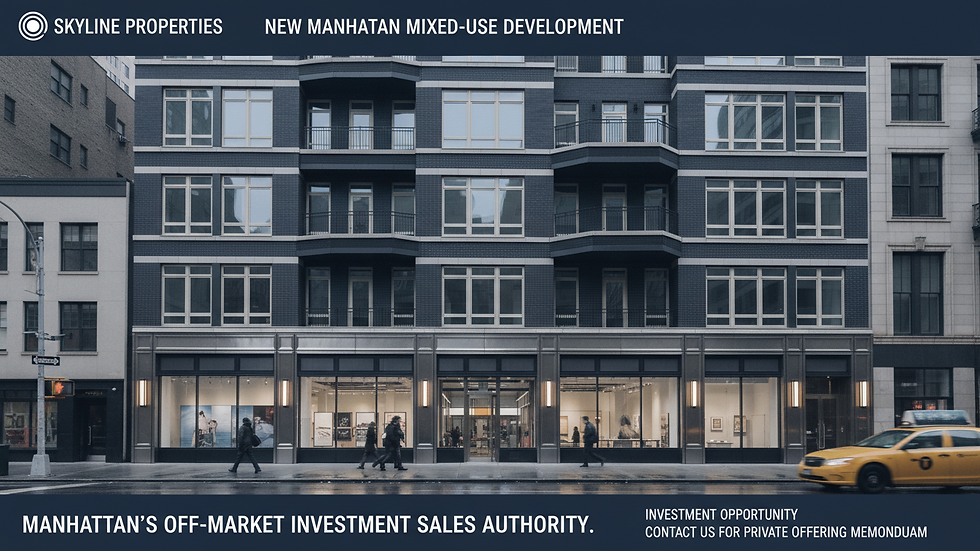
Locating mixed-use properties in NYC requires access to off-market opportunities and a deep understanding of submarket dynamics. Skyline Properties, as Manhattan’s Off-Market Investment Sales Authority, leverages proprietary networks and data to identify assets before they reach the broader market.
Key strategies include:
Direct Owner Outreach: Engaging with property owners or their representatives confidentially to assess disposition interest.
Monitoring Zoning Changes: Tracking areas with recent or pending zoning amendments that enable mixed-use development or conversion.
Analyzing Transaction Data: Reviewing historical and current sales to identify patterns and emerging submarkets.
Leveraging Broker Networks: Collaborating with local brokers who specialize in mixed-use assets and understand owner motivations.
For buyers, providing clear parameters such as asset type, preferred submarket, and price range enables brokers to tailor searches effectively. For owners, submitting the property address for a confidential review initiates a discreet valuation and marketing process.
Commercial Considerations in Mixed-Use Investments
Investing in mixed-use properties requires a nuanced approach to valuation and underwriting. The income streams from residential, retail, and office components often have different risk profiles and lease structures. For instance, residential leases tend to be longer-term and more stable, while retail leases may be shorter and more sensitive to economic cycles.
Ground leases and office-to-residential conversions are increasingly relevant in this sector. A 99-year ground lease can provide long-term income with limited operational responsibilities, appealing to certain investor profiles. Meanwhile, office-to-residential conversions, such as the 467 Madison Avenue project, reflect adaptive reuse trends responding to market demand shifts.
Understanding local market rents, vacancy rates, and tenant credit quality is critical. Additionally, regulatory factors such as rent stabilization laws and building codes impact operational flexibility and returns.

Navigating Regulatory and Zoning Challenges
Zoning regulations in NYC significantly influence mixed-use property opportunities. Many neighborhoods have specific designations that permit or restrict combinations of residential, commercial, and industrial uses. Recent rezoning initiatives in areas like Long Island City and Downtown Brooklyn have expanded mixed-use development potential.
Owners and investors must conduct thorough due diligence on zoning compliance and potential for future development or conversion. This includes understanding FAR (floor area ratio) allowances, parking requirements, and community board considerations.
Ground lease advisory is another critical service in this context. Proper structuring of ground leases can unlock value while managing risk, especially in development sites or properties with complex ownership structures.
Engaging with Skyline Properties for Mixed-Use Opportunities
Skyline Properties maintains a disciplined approach to mixed-use property sales in NYC. Our role as Manhattan’s Off-Market Investment Sales Authority means we prioritize discretion, accuracy, and commercial intelligence in every transaction.
If you are considering selling or acquiring a mixed-use asset, I encourage you to engage directly. For owners, send the property address for a confidential review. For buyers, send your asset type, submarket, and price range. This initiates a focused conversation grounded in verified data and market insight.
Our experience with multifamily investment sales NYC and Manhattan development site sales positions us to advise on complex mixed-use transactions effectively. We understand the nuances of commercial property valuation NYC and can guide you through ground lease advisory NYC and office-to-residential conversion NYC opportunities.
For more information on mixed use property sales nyc, contact Skyline Properties directly to discuss your specific needs.



Comments